The case for British flowers: seasonality, place and people
Flowers have a way of holding meaning in the quietest, most powerful way. They can frame a moment without overwhelming it. They soften spaces, bring movement and create a wider sensory experience.
At weddings, flowers are one of the most memorable visual threads woven throughout the day. From the bouquet held by the bride to the tables guests gather around, flowers help to tell the story of a couple’s love. At funerals, they reflect the individuality and spirit of the person being remembered.
At May & June, we have come to see flowers not just as flowers but as something far more layered. Every stem tells a story – of a season, a place and the hands that nurtured it into being.
The beauty of seasonality
There is a reason chefs use local, seasonal ingredients. They taste better, fuller, richer.
This same principle applies to flowers. When we use local, seasonal flowers, they are more beautiful, more fragrant, more alive. They have not been forced to grow with chemicals. They have not travelled long distances or spent days in transit. Instead, they have been nurtured to life by a passionate British grower, the soil and the light around them.
Grown outdoors rather than in controlled environments, British flowers tell the story of the landscape around them. They are full of character. They arc, sway and dance. Their petals curve, their stems twist, their colours shift as delicately as watercolour on paper. There is a sense of spontaneity to them, as though they have just been gathered from a garden.
That’s because, in many ways, they have.
The flower is harvested at just the right time, popped straight into water and then delivered straight to us.
The global flower trade
According to Flowers on the Farm, the UK spent £3.8bn on cut flowers in 20231, the majority of which were imported. Indeed, we see bunches of flowers in the supermarket all year round without thinking much of it. Before launching May & June, it is not something we thought about much either.
In reality, the global flower trade is a huge, complex system. The biggest growers and exporters are the Netherlands, Ecuador, Colombia, Kenya and Ethiopia2.
Imported flowers move through what is known as a “cold chain” – a continuous network of refrigerated storage and transport2. From farm to lorry, to plane, to distribution centres. They are kept at carefully controlled temperatures to slow their ageing process and preserve their appearance.
Crucially, flowers lose 15% value for every day they spend travelling which puts pressure on speed, logistics and efficiency across the whole network.
But with the speed and efficiency come some trade-offs…
Environmental considerations
Refrigerated planes, storage facilities and vehicles all require energy and the speed at which flowers must be shipped only adds to that demand.
Research published by Lancaster University4 showed that an imported mixed bouquet (31-32kg) produces almost 10 times greater carbon emissions than a British grown one (3kg). Locally grown flowers are the most environmentally friendly, with the lowest CO2 emissions (1.7kg)6.
If we put these figures into perspective, the carbon footprint of 1000 plastic bags is 33kg and a one way economy flight from London to Paris is 40kg7.
And yet, even here, the picture is not entirely straightforward.
You would likely assume that Dutch imported flowers have a lower carbon footprint than Kenyan imported flowers. However, flowers grown in warmer climates benefit from natural sunlight and stable temperatures. This can reduce the need for artificial heating and lighting, which are often required in European greenhouses, particularly during colder months.

In some cases, this means that the environmental impact of growing flowers abroad may be lower than growing them out of season in energy-intensive conditions closer to home.
It is a gentle reminder that sustainability is rarely a simple, one-size-fits-all answer. It is a balance of factors but what is very evident is that British flowers have a significantly smaller carbon footprint.
The human stories behind stems
Beyond the environmental impact, there are also important human stories to consider within the global flower trade.
It provides livelihoods for millions worldwide, creating jobs, supporting families and contributing to local economies. Many farms are making positive strides in investing in more sustainable practices too.
At the same time, there have been some well-documented challenges within parts of the industry.
Reports have highlighted issues such as low wages, long working hours, forced labour, child labour and sexual harassment, especially for women who make up a large proportion of the workforce in the flower trade7.
The Gender, Rights & Participation in the Kenya Cut Flower Industry report7 states that, “One aspect of abusive treatment is the sexual harassment by male supervisors reported on all farms, in both packhouses and greenhouses. Respondents claimed that supervisors request sexual favours in exchange for employment, time off, promotion, and bonuses.”
Then there are the concerns around exposure to chemical pesticides.3
A coordinated research programme8 9 10 on florist exposure to pesticide residues found that cut flowers can carry multiple pesticide residues, some of which are acutely toxic and exceed recommended safety limits. One of the studies detected the residues in urine samples11 indicating that these substances can be absorbed into the body during handling and have the potential to cause long term health risks.
The goal of May & June is not to point fingers or make blanket statements about other floral businesses, or indeed entire countries and industries. It is instead about making our own choices thoughtfully and taking the time to understand where the flowers we are working with come from.
When we look closer to home at British flower growers, a different kind of human story begins to emerge.
Growers are very often small, independent businesses run by passionate individuals – in many cases, women – who are deeply committed to their work. They are directly involved with the growing process, tending to the flowers from seed to harvest. The flowers are not products moving through a global system but the result of considered choices made by individuals who care deeply.
There is a level of transparency and proximity that feels important because we know where the flowers are coming from and who has grown them. Working within the UK also means operating within established regulatory frameworks that support safe working conditions.
Both systems – global and local – are made up of people, each with their own expertise, challenges, and contributions. Recognising the human element in both helps us appreciate the wider picture, and reminds us that behind every stem, there are hands, skills, and stories that deserve to be acknowledged.
A collective shift
Perhaps the most important thing to hold on to is this – no single person can transform the industry overnight.
But collectively, small conscious choices begin to add up.
Choosing seasonal flowers. Asking where stems have come from. Being open to what is naturally available. Supporting local growers. Stopping using floral foam (or at least committing to using less of it).
There are many ways to create something beautiful. What matters most is keeping the conversation open, continuing to learn and supporting one another to make informed choices where we can.
At May & June, our decision to focus on British flowers is a personal one. It reflects what matters to us – seasonality, connection to place, and most importantly human stories.
A different kind of luxury
In many ways, choosing British flowers is about redefining what luxury looks like.
Rather than perfection and uniformity, it becomes about seasonality and authenticity. Rather than abundance without context, it becomes about intention and connection.
It is about allowing flowers to be what they naturally are — fleeting, expressive, and deeply tied to a moment in time. Flowers are never meant to last forever. Their beauty lies in their transience – in being fully present, exactly as they are, in that moment.
A final thought
It’s easy to feel overwhelmed when thinking about sustainability. There are so many layers, so many perspectives and so many factors to weigh up.
But it doesn’t have to be all or nothing.
Even small, considered choices can carry meaning.
Choosing British flowers is simply one of those choices – a way of celebrating not just beauty, but also seasonality, locality, and the stories behind each stem.
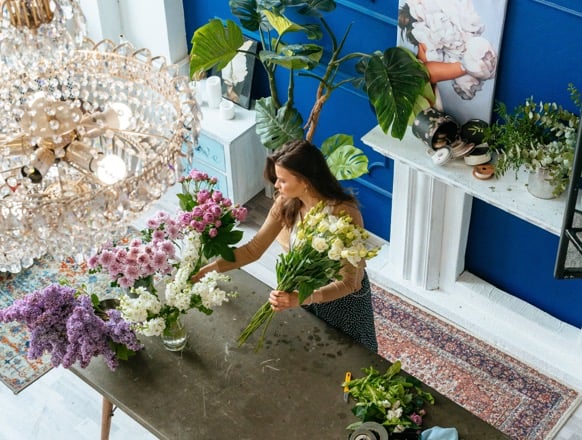
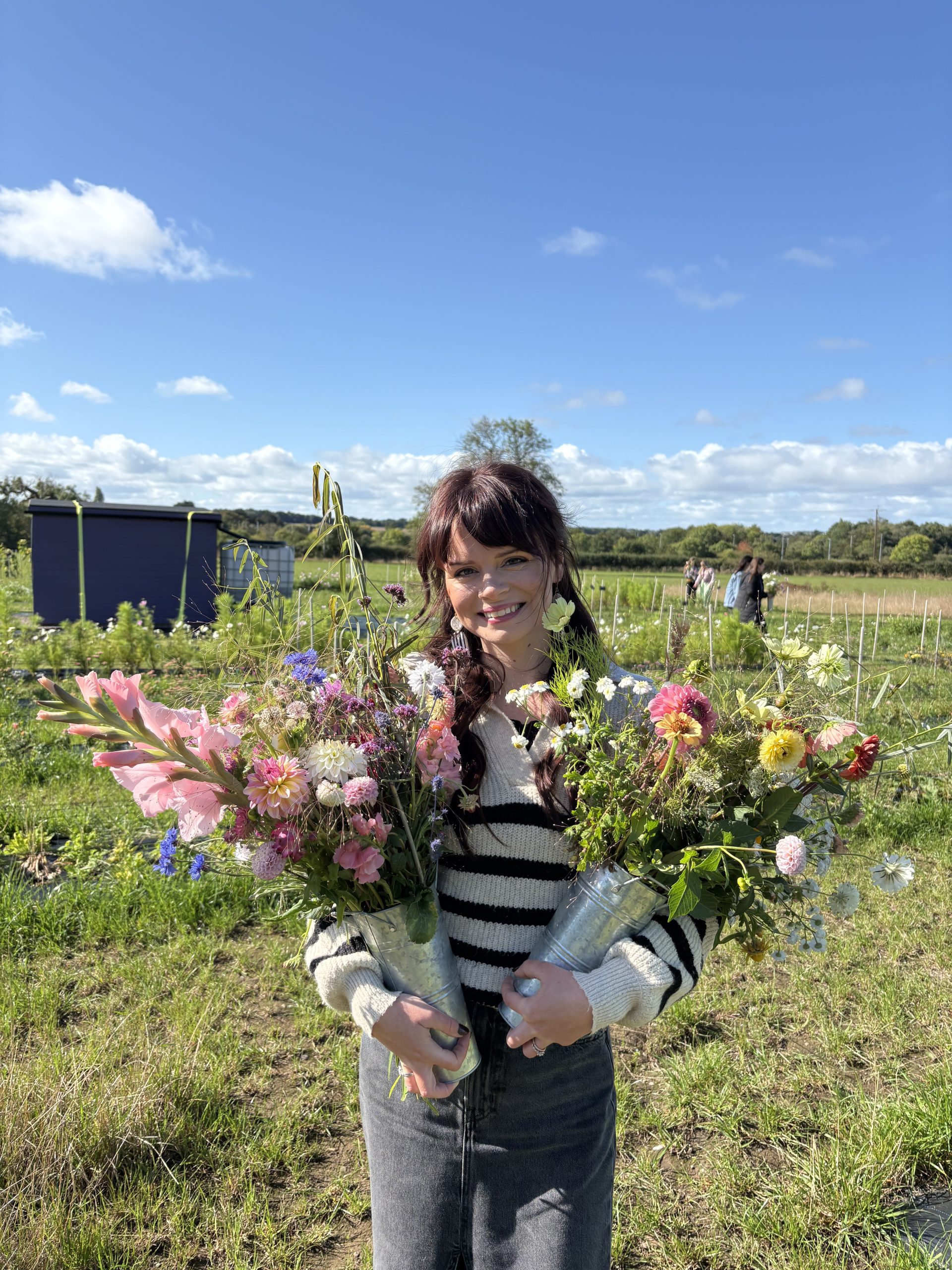
Founder of May & June, Sheilagh, handpicking flowers from Life On The Lot in Wirral




Sources
Why British Flowers, Flowers From The Farm
https://www.flowersfromthefarm.co.uk/inspiration/why-british-flowers
The New Roots of the Flower Trade, BBC
https://www.bbc.com/future/bespoke/made-on-earth/the-new-roots-of-the-flower-trade/
Are roses for Valentine’s Day the ultimate symbol we really don’t care? Live Frankly
Are roses for Valentine’s Day the ultimate symbol we really don’t care?
Say it with British flowers, Lancaster University
https://www.lancaster.ac.uk/sci-tech/about-us/news/archive/2018/feb/say-it-with-british-flowers/
Carbon footprint of Common Items, Clever Carbon
https://clevercarbon.io/carbon-footprint-of-common-items
Farm of the Future: Journey to Net Zero, Royal Agricultural Society of England
https://www.rase.org.uk/content/large/documents/reports/farm_of_the_future-_journey_to_net_zero.pdf
Gender, Rights & Participation in the Kenya Cut Flower Industry, Natural Resources Institute
https://assets.publishing.service.gov.uk/media/57a08d49ed915d622c0018d5/R8077a.pdf
Pesticide Residues on Three Cut Flower Species and Potential Exposure of Florists in Belgium
https://pmc.ncbi.nlm.nih.gov/articles/PMC5086682/
Risk Assessment of Florists Exposed to Pesticide Residues through Handling of Flowers and Preparing Bouquets
https://pmc.ncbi.nlm.nih.gov/articles/PMC5451977/
Biological monitoring of exposure to pesticide residues among Belgian florists
https://tinyurl.com/hhjx9umc

We are May & June where romantic, enchanting blooms are crafted with quiet care and intention. Each flower is thoughtfully selected for its unique beauty; the gentle curve of a petal, a delightful twist of a stem, or a hue as delicate as watercolour.
Tags
Related musings
What flowers do you need for a wedding?
“What flowers do we need?” is one of the most common questions couples ask when they begin planning their wedding. Here’s a simple guide to the floral pieces you may wish to include.

What British flowers are in season in May and June?
If you are planning a wedding or special event for May or June, you will have a wonderful selection of British flowers to choose from. This guide explores some of the most loved and widely used British flowers in season.
Finding my way back to myself through flowers
My first season at Tallulah Rose Flower School was in autumn. What I could never have anticipated was just how magical the experience would be…